
"The Madman" of Taoufik Jebali : Why is it a masterpiece?

May 19
6 min read
Updated: May 21
If the esteemed Lebanese artist and poet Gibran Khalil Gibran were to awaken from his eternal rest, he would undoubtedly thank Taoufik Jebali and his entire team of actors and technicians for their remarkable interpretation of his masterpiece "The Madman" (Al Majnoun) on May 18, 2026.
Their presentation featured, with no doubt, an intelligent set design, along with a diverse array of well-crafted melodies, paintings, and scenes.
This live performance, that took place in the El Teatro Studio, was a textual force spreading in all corners of the stage with Taoufik Jebali's gravelly, dense voice and his ironic tone.
"The Madman" a 26-year-old play
"The Madman", this 26-year-old play, is a work in progress. In yesterday's interpretation, Taoufik Jebali added effects to multiply the imaginary characters.
"The Madman" in fact, has been evolving for more than two decades and has now reached the level of a masterpiece on both the Arab and even global scale.
The success of the play "The Madman" can be explained, partly, by its profound expression within Arab culture.
"The Madman" combines, thus, eroticism, piety, and rationalism. Taoufik Jebali has skillfully managed to blend these three ingredients.
Also, the scenes of Gibran Khalil's poetic words were adorned with stage canvases. The audience, during an hour and a half of intense and very physical performance by the actors, was kept on the edge of their seats and glued to their chairs.
The viewers were stunned by the modernity of the scenographic techniques used and the strength and intensity of this artistic feat.
Taoufik Jebali describes "The Madman" as follows : "The technology used in the performance does not rely on any complex technology, contrary to what it may seem, but simply on an ordinary projector, without holograms or similar things." Moreover, this work was presented in its first version in 2000, and the current reprise is the fifth. […] Each person perceives art in a different way, influenced by their experiences, preferences, and cultural background".
As with previous performances, the audience flocked to "The Madman" as it was not always an available play. In fact, they wanted to see a show that the entire dramatic arts community couldn't stop talking about.
The play, "The Madman", requires full commitment
The hour and a half of this representation was, for all the actors, almost a full physical exercise session; there was a constant demand from them to be energetic and beautiful and to have an intellectual and material presence.
Apart from 15 minutes of reading Gibran's texts at the very beginning, the rest of the play is then on mime, percussion, and staging that employs subliminal theatrical skills.
The actors are assisted in their effort to inhabit the space by this scene management technology, which has tremendous stage resonance and fits into the alchemy of motions.
Upon closer inspection, the performers' portrayal serves the director, who is the real star of "The Madman". Through his absence, he is present. All we hear is his voice, which conveys his suffering, anguish, insanity, ignorance, wounds, grief, inability, frustrations, misinterpretation of the tortured reality, and, lastly, his alienation from this existence.
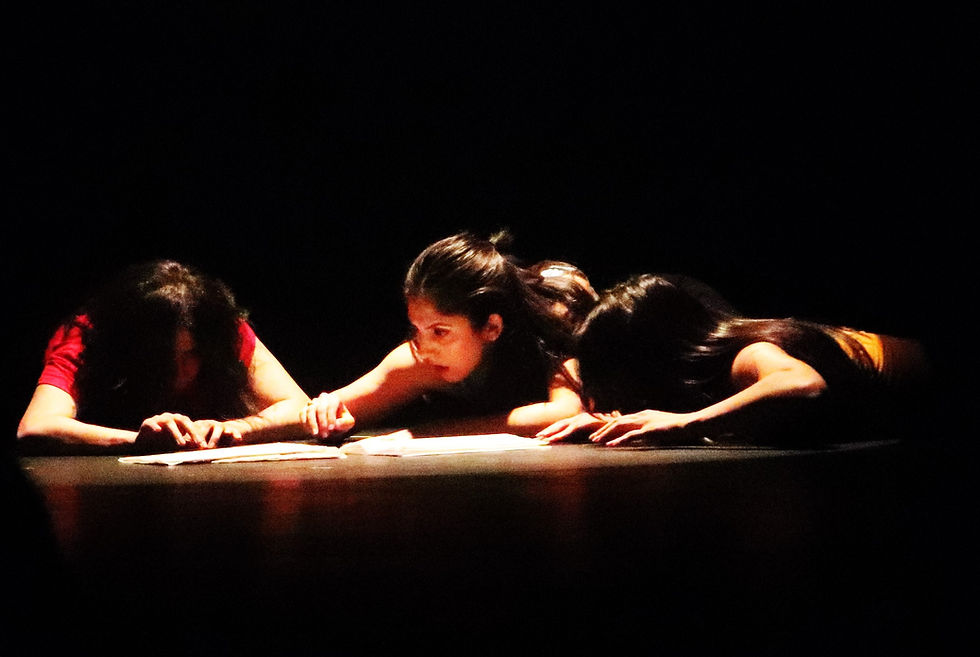
The quartet on stage, namely Yasmine Dimassi, Amel Laouini, Amina Bdiri, and Marwen Errouine, were in a dreamlike alchemy.
"The Madman" was almost like experiencing a mystical event that hovered between a dream and a nightmare for the audience in a poorly illuminated and dark atmosphere.
On stage, Taoufik Jebali's actors played hide-and-seek with the audience. These actors have presented themselves to the audience after first establishing their desirability. This feature is unprecedented.
In other words, they become rare and often conceal themselves behind an impenetrable veil. In the darkness, spectators may only catch a glimpse of the head. At other times, they might see just the feet, hands, faces, or movements emerging from the shadows or even appearing behind a ball of fire.
At other times, they play at the rear of the stage beyond a curtain with lighting that only reveals a portion of their bodies and their shadows. They are also visible inside a black box.
As a result, the scenes were devoid of words and consisted solely of gestures that alternated between protest, expressiveness, and aggressive movements in a tragic musical setting.
The presence of actors was, then, one of the most beautiful aspects of this work, as the uncommon harmony between them was evident, as if they were not performing separate roles but rather forming a single body and spirit moving as one actor.
They gave this performance its sincerity, sensitivity, and human warmth. They devoted their bodies, voices, and emotions entirely to this troubled poetic masterpiece, making every movement, every glance, and every silence pulsate with life and meaning.
Impression of one spectator about "The Madman"
When watching "The Madman", the audience often feels a reflection of themselves on stage : their fragility, fear, longing for love, desire to escape, and even their weariness from the pervasive absurdity.
Perhaps that's why many in Tunisia return to this performance repeatedly : because they discovers new things and new questions awakens in each view.
"It is difficult to speak about "The Madman" of Taoufik Jebali as an ordinary theatrical representation because what happens on stage transcends the idea of mere entertainment toward a complete emotional experience", Nour Elomr Ouni wrote one spectator of this play.
"An experience that places the audience in front of themselves more than in front of characters or events", he said.
"There are works that you watch once and understand, and there are other artworks that you return to, because something in them remains incomplete within you", he added.
Maybe because they do not tell their meaning all at once, but rather seep into you slowly. "The Madman" is one of those rare types of works, he stated.
"Based on the text by Khalil Gibran, Taoufik Jebali does not merely rewrite the text theatrically but creates another life for it, more physical, more turbulent, with more effects and closer to today's life", asserted Nour Elomr Ouni.
"For here, Gibran is not just a writer to be quoted but a complete spirit hovering above the stage—a spirit of a poet, philosopher, and mystic who sees the world with a restless and astonished eye at the same time", he told.
"From the very first moments, the audience enters a surreal state-shadows, bodies, music, whispers, screams, spinning, light that dims and returns, and words that sometimes seem to emerge from within us, not from the actors' mouths", concluded Nour Elomr Ouni.
Visual and auditory aspects
"The Madman" stands out as a masterpiece due also to its captivating visual and auditory elements. These elements serve not merely as a backdrop for the performance; they are, in fact, its beating heart.
These aesthetic components created a living space that is in a constant state of transformation : a space where light communicates, sound is alive, and even darkness contributes to the overall meaning.
What makes this play exceptional is that its rare ability, visually, to combine chaos and precision. Everything seems chaotic, but calculated with high sensitivity.
Dance is not mere decoration, music is not just accompaniment, and lighting is not merely a technical element; every detail in this play "The Madman", transforms into a language of its own.
The entire performance appears to communicate with a cohesive internal rhythm, reflecting the turmoil experienced by modern individuals seeking meaning amid the harsh realities of everyday life.
Within this representation, madness, visually, is not presented as an illness but rather as a kind of painful clarity : as another way of seeing things away from social masks, positions, and ready-made certainties.
It is an artwork of genius whose presentation is characterized by a creative fidelity to Gibran's text by adding small nonverbal dramas that are rhythmic, symbolic, dreamlike, and even sensual.
Moreover, the ambient music is made with breathtaking percussion that carries the spectator into an environment that is deeply internal and external.
"The Madman", an invitation to reflective thought
What is also impressive, when you see "The Madman", is that the dramatic behavior, despite its philosophical depth and poetic density, does not fall into intellectual arrogance.
On the contrary, there is a clear intention in it to share life experience in every moment of it.
In other words, the representation does not seek to indoctrinate the viewer; rather, it gently invites him to reflect, to listen to himself, and to accept his contradictions, as well as his incoherence, perplexity, and madness.
"The Madman" is not a show that you simply consume and forget. It is one of those artworks that lingers within us, like distant music or a memory whose beauty causes us pain for reasons we cannot fully grasp.
Every time they watch it, the audience realizes that, in addition to the stage, their own perceptions on the world and each other are evolving.
There is confusion in "The Madman", full of vitality, and craziness. But what amazing insanity!
Even without compassion and love, madness possesses a unique beauty in Jebali's way.
Taoufik Jebali has been refining this artwork since 2000, producing five versions until today. The play "The madman" has now achieved a remarkable level of perfection in terms of presentation and acting. It deserves to go see it, without any reservation.


Comments